In the 1980s, the Thatcher government set about privatising all public services including utilities, transport, and healthcare. The 1988 Education Act created a quasi-market introducing per-pupil finding, league tables, and more autonomy over admissions.
Fifteen years later, LSE researchers observed the effects. “Schools that are their own admission authority are in a position to ‘cream skim’. This means that they are able to select pupils who will maximise their examination ‘league table’ results.” The study found that between 1988 and 2003 the proportion of schools determining their own admissions had doubled to 30%. (West & Pennell, 2003).
The 2010 Academies Bill put school deregulation on steroids. By 2020, over 95% of grammars had converted to academies, leaving them free to define their own entrance tests. My 2017 paper on the effects of tutoring on the 11+ recommended creating independent admissions authorities, regulating the test, and linking test results to the National Pupil Database. However, to this day, the 11+ remains the only unregulated high-stakes test.
Duopoly of providers
- 1946: The National Foundation for Education Research (NFER) was founded as a charity providing 11+ tests. This provided some degree of national consistency.
- 1980: NFER created a limited company, NFER Nelson, to provide tests commercially.
- 1983: Durham University set up the Centre for Evaluation and Monitoring (CEM) as a research project.
- 2000: NFER sold this commercial test provider which became Granada Learning Assessment (GLA).
It is not clear when CEM started providing 11+ tests, but by 2010 GLA still had a virtual monopoly on commercial testing.
The rise of the “tutor-proof” 11+ test (2013 – 2016)
The earliest documentary reference to “tutor-proof” tests is from February 2013 when the BBC reported, “Grammar schools in Buckinghamshire are changing the 11+ to make it tutor proof and to test a wider range of abilities.” Mike Appleyard, Buckinghamshire Council cabinet member for education said the new CEM test would be, “less coachable than the current [GLA] test.” A council briefing paper explains that, following a competitive tender, CEM ran a pilot which concluded its test, “was fair for children whatever their gender, ethnicity or social background.”
In July 2013, local grammars created The Buckinghamshire Grammar Schools (TBGS) a private limited company to manage the test. TBGS first administered the test in 2013 (for 2014 entry). In February 2014, the Observer quoted Philip Wayne, chairman of TBGS saying, he was ““very confident” that [CEM’s] new test will avoid the current situation, in which many pupils who won places at his school with the help of intensive tutoring struggle to keep up with lessons once they arrive.”
The hyperbole reached its peak in September 2016 when the prime minister, Theresa May, gave her ‘Great Meritocracy’ speech to promote expanding selection. May said, “many selective schools are already employing much smarter tests that assess the true potential of every child. So new grammars will be able to select in a fair and meritocratic way, not on the ability of parents to pay.”
The fall of the “tutor-proof” test. (2016 – 2021)
Three days after May’s speech, the Guardian reported, “‘Tutor-proof’ 11-plus professor admits grammar school test doesn’t work.” The article cited Prof Rob Coe, the then director of CEM, admitting they had withdrawn prior marketing claims that their tests could assess ‘natural ability.’
The Education Policy Institute (EPI) published research into tutor-proof claims. This compared how children from state and private schools fared after TBGS introduced CEM’s tests in Bucks.
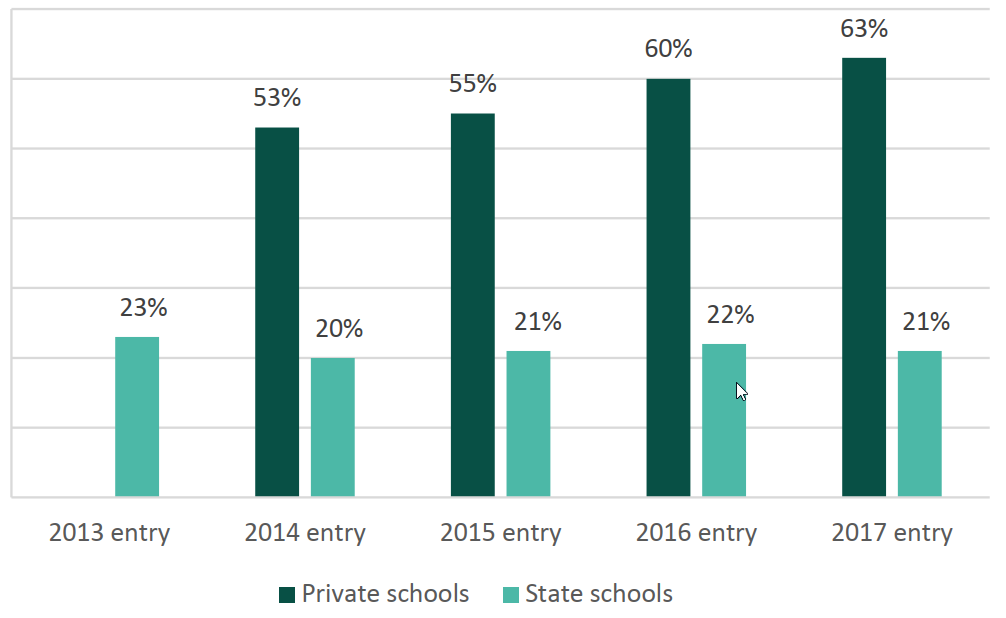
The pass rate for state educated children was consistently 21% (±1%). Over the same period, the proportions of privately tutored children increased from 53% to 63%.
Within six months, School’s Week reported, “Grammar schools in Buckinghamshire have sacked their high-profile 11-plus test provider and reappointed their former supplier.” The article clarifies that CEM, “did not put in a bid to renew its contract”.
CEM’s share of the 11+ test market peaked in 2016 when 81 of the 163 grammars used their tests. By 2019 this had dropped to 59. From 2021, remaining grammars began to announce that CEM had withdrawn altogether from the market.
Tutor resistant strategy
In high-stakes tests, from KS2 SATs to University degree modules, examiners provide past papers so that candidates know what to expect in the test. GLA offer 10 hours of free test material via its website. This explains, “our practice papers are the best preparation to help build confidence before taking 11+ admissions tests.”
CEM took a different approach. “Part of CEM’s strategy in making its tests ‘resistant to tutoring’ is to not publish past papers or practice papers, or the algorithms used to produce the standardised scores.” (Information Tribunal decision, §24).
CEM’s lack of preparation material may have a far simpler explanation. 11+ test providers create exam papers from a ‘bank’ of questions. Each question can appear in multiple tests. CEM would be unable to use any questions which appeared in preparation materials elsewhere.
Although they were never asked to disclose any test content, CEM told an earlier Tribunal (at §31) that, “Releasing the information would make future tests more expensive by increasing costs for the University whilst simultaneously de-valuing the bank of test content it holds for re-use in future commercial opportunities.”
No supporting evidence
In 2015 Schools Week reported an unsuccessful attempt by the Buckinghamshire campaign group Local Equal Excellence (LEE) to get CEM to disclose evidence to support the “tutor-proof” claims.
- LEE told Schools Week, “CEM should either publish their evidence or stop making claims that have no basis in fact.”
- The ICO’s position was, “There is public interest in protecting the methods by which CEM is attempting to deliver a fairer testing system.” The ICO recognised it was too early to ascertain whether CEM’s methods would be successful or not, but said they needed to be given a fair chance to succeed.
- CEM said, “the university did not claim that its tests were “tutor proof”, but developed to minimise the impact of “additional coaching”. A semantic rather than substantive distinction!
What muddied the waters is that CEM themselves avoided making specific factual claims. They remained silent whilst others made unsubstantiated claims without any supporting evidence. In 2012, their income was £330k. By 2016, half the country’s grammars were using their tests. Income had risen to £815k.
Is a tutor resistant test fairer?
No one would disagree with the Information Commissioner that it is in the public interest for admissions tests to be as fair as possible. However her conclusion that CEM should not disclose any information about its tests was based on the assumption that making the test more tutor resistant makes it fairer.
It is not possible to keep the content and structure of tests seen by fifty thousand children year secret. Prep schools and tutors debrief candidates after each test to help prepare future students. Their whole raison d’être is to assist children to obtain places at selective schools which many parents consider provide a better education than comprehensives whilst still being state funded.
The EPI research shows that when TBGS introduced CEM’s “tutor resistant” test in Bucks, the proportion of privately educated children increased by 10% between the 2014 and 2017 intake cohorts. This rose from 53% to 63%. Over the same period, the proportion of state educated children remained just above 20%.
Grammar school expansion
On 12 September 2016, the government published its green paper Schools that work for everyone. That included a proposal to lift restrictions on creating new grammar schools.
The government argued that grammars promote social mobility. However, research by the Sutton Trust showed that poorer children were not being admitted in the first place. “the challenge … is how to ensure that those grammar schools are open to all, and are not simply the preserve of better off families who can afford private tutors or prep school fees.”
Commons Select Education committee evidence.
On 8 November 2016 the Commons Education Committee took evidence from leading academics and the government. The whole session was over two hours long. There is no transcript, but the following two short clips deal directly with the “tutor-proof” test and its impact on fairness. (NB the videos start at the correct position but do not automatically stop.)
Video 10:34:00–10:35:48. (108 seconds.) The committee heard from Dr Rebecca Allen, former Director of the Centre for Education Improvement Science, UCL.
- The CEM test was intentionally unpredictable to make it hard to tutor but there was no evidence at all that at all that students did not gain from tutoring to prepare for these tests.
- After the Bucks grammars introduced CEM’s tests, the proportion of children in receipt of Free School Meals they admitted dropped.
- Faced with uncertainty over what the test would contain her own response, as a parent, would be to put her children through years of tutoring to cover all bases.
The other witnesses universally agreed that the tutor-proof attempts had been counter-productive.
Video 11:53:54–11:54:46. (52 seconds.) MP Catherine McKinnell summarised the evidence.
- Attempts to make the test “tutor-proof” had increased the amount of tutoring needed to do well in the tests.
- This resulted in a system which was less fair.
Government Chief Scientific Advisor for Education, Dr Tim Leunig said the grammars had introduced the CEM test in Bucks for the right reasons but it did not work and they needed to withdraw it. Within six months, TBGS announced they were reverting to using GLA’s tests.
Grammar expansion Mk II
Schools Minister, Nick Gibb, told the committee that a tutor proof test remains the ‘Holy Grail’ of selective education. Both The Guardian and Schools Week ran with this colourful metaphor.
Crucially, Gibb also acknowledged that poorer pupils were less likely to get into grammar schools, undermining the arguments for increased selection. The government backed down on its plans to repeal primary legislation preventing the creation of new grammar schools. Instead, they announced the £50m/year Selective Schools Expansion Fund.
Damien Hinds said selective schools would, “only be able to expand if they meet the high bar we have set for increasing access for disadvantaged children.” From the outset, this was predicted to fail unless places were ringfenced. Actual outcomes from the first tranche of SSEF funding were underwhelming. The BBC found that although grammar school places had increased by 19%, “King Edward VI grammar schools in Birmingham are among the few to have achieved radical changes, by introducing a quota of 25% of places for pupils from the lowest income families.”
Wishful thinking.
The tutor-proof myth appears to have been the product of wishful thinking, Chinese whispers and a willingness to overlook the actual evidence.

Transparency
Since 2014, CEM have been refusing to disclose even the raw tests scores from their tests. In a bizarre twist, they argue that this would reveal the content and format, help tutors and damage their commercial interests.
In Coombs v ICO EA/2015/0226 Judge Hamilton said there was, “evidence that the claimed USP of tutor-proofing was highly questionable and that the public interest warranted close examination of this claim which could only be achieved through the disclosure of the disputed material.” This ongoing battle for transparency has been the subject of half a dozen court appeals are covered in this article.

Recent Comments