Has the Selective Schools Expansion Fund achieved its aims?
In 2018 Theresa May’s government announced the Selective Schools Expansion Fund (SSEF). £200m funding over four years to expand existing grammar schools. Damian Hinds explained that this would enable disadvantaged children to attend grammars, “I have always been clear that selective schools will only be able to expand if they meet the high bar we have set for increasing access for disadvantaged children, and all of these schools have done that. As a result, countless more children from disadvantaged areas will benefit from places at outstanding schools.”
Now that the first tranche of children benefitting from this policy have started school we can see how effective this £50m of public funding has been at getting more disadvantaged children into grammar schools.
Spoiler alert. It’s underwhelming.
Each of the schools were asked how many offers were made and how many of them went to disadvantaged children. This plot shows the mean ‘before’ figures for 2017-2019 provided by the DfE and numbers of offers made in March 2020 provided by the individual schools.
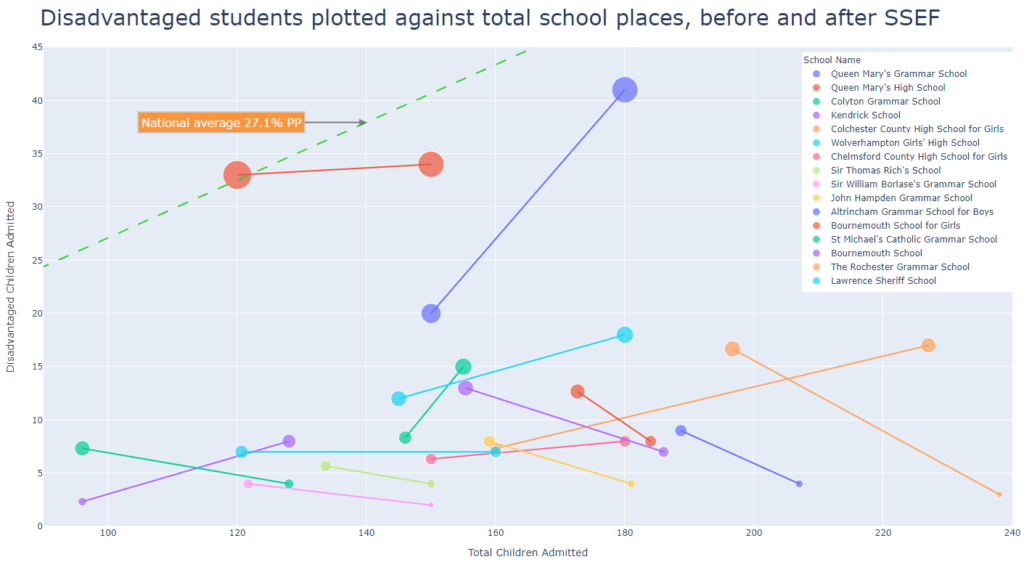
The plot shows total on roll (x-axis) against disadvantaged children (y-axis) with the green dotted line showing the national average. Each line shows the ‘before’ and ‘after’ for an individual school. Schools near the dotted green line are approaching national averages for inclusivity.
Crystal ball work
I told The Guardian in February 2019 that the only effective way to get grammars to admit representative numbers of disadvantaged children was to implement a quota system. Only two schools come anywhere near to reflecting the normal proportion of disadvantaged children – the two “St Marys” in Walsall. Both set aside 30% places for disadvantaged children.
- Queen Mary High (Girls – red line) had already implemented quotas before the SSEF. All credit to the governors’ principles, but the SSEF didn’t contribute to this achievement.
- Queen Mary Grammar (Boys – blue line) introduced quotas as a condition of the grant and the effect is marked. This is the only school which has seen a significant improvement.
Based on a closer look at the actual proposed admissions arrangements and past test results, I predicted at best 2 or 3 of the thirty new places being created at Kendrick School in Reading and Buckinghamshire’s William Borlase’s and John Hampden would go to disadvantaged children.
Kendrick exceeded this, increasing their mean intake of two and a third children out of 96 (2.4%) to eight out of 128 (6.25%). This is heading in the right direction but still a long way to go. By contrast Buckinghamshire’s William Borlase’s and John Hampden appear to have gone backwards.
- William Borlase reduced the number of disadvantaged children admitted from 4 (3.3%) down to 2 (1.3%)
- John Hampden reduced the number of disadvantaged children admitted from 8 (5%) down to 4 (2.2%)
Altrincham School said their target was to admit 15% disadvantaged (still only half the national average) by 2023. They have dropped from admitting 4.8% (9) to less than 2% (4)
The policy
The SSEF policy handed out cash to schools who promised to do something to address the underrepresentation of disadvantaged children in grammar schools with no sanctions for those which failed. The only two which approach normal numbers of disadvantaged children were already operating a quota system before the grant was awarded. The grant made no difference.
If the government were serious about funding places for disadvantaged children the sensible way to do this would be to fund new ring fenced places which don’t “take away” places from the middle classes. The SSEF created an additional 500+ Y7 places – 2,500 places in total. That’s the equivalent of building three entirely new grammar schools. Of those five hundred Y7/2020 places, eleven* went to disadvantaged children at a cost of £4.4 million per disadvantaged child.
The SSEF was Theresa May’s method of circumventing primary legislation which outlaws the creation of new selective schools. Who could’ve seen that one coming in 2018?

*Caveat
The figures shown here are based on offers made in March 2020. Schools Week published an article based on this information (£50m for expansion, but some grammars get less inclusive) but included corrected figures for numbers of disadvantaged children who actually started in September. Between them seven of the schools originally said they had made 51 offers to disadvantaged children but 89 subsequently joined.
This appears to be because secondary schools genuinely do not know which children are entitled to PP funding until they start school in September. This means the above graph is probably pessimistic, but if parents of disadvantaged children don’t even realise that they have preference in the admissions process, the schools are clearly not getting ths message across.
The SSEF policy was announced in 2018 but due to the long ‘lead time’ in changing admissions, the official reporting of Pupil Premium numbers won’t be captured until the next spring census. We need to wait until April 2021 to fully understand the effectiveness of the Selective Schools Expansion Fund.

Leave a Reply