Parents choice over which school their children attend is theoretically sacrosanct but in practice restricted whenever schools implement selection by aptitude faith or gender. Queen Elizabeth Grammar School in Faversham, which selects on ability, have recently consulted on opening an ‘annexe’ in another town. This prompted a request to enhance my map of England’s selective/non-selective secondary schools to include Kent’s faith schools. I decided to add gender, numbers on roll and the average prior attainment (KS2APS) based on DfE figures. Here’s a link to the map.

Queen Elizabeth Grammar explain they based their expansion bid on the five-year plan published by Kent County Council (KCC) which sets out the council’s desire to establish a five form entry (5FE) ‘satellite’ grammar provision on the coast. Grammar schools opening an ‘annexe’ tends to be controversial. The Canterbury District is broken into three planning areas;
- Canterbury City Non-Selective,
- Canterbury Coastal Non-Selective and
- Canterbury and Faversham Selective.
KCC’s plans explain, “If new housing is delivered in line with the Local Plan it is forecast that there will be a gradual increase in the need for Year 7 places across the Plan period, increasing from 37 in 2019 to 133 by 2023.” The supporting figures appear in this table:
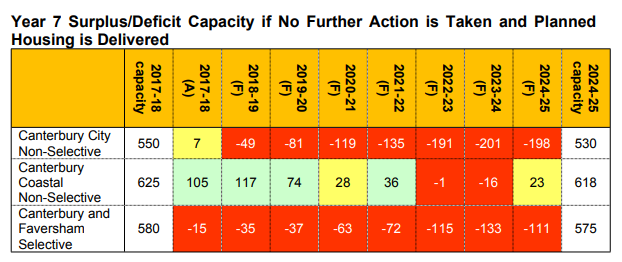
Instantly this looks wrong. Each planning area has roughly the same capacity and so grammars provide about a third of the places but Kent’s policy is for 25% of pupils to attend grammars.
Before leaping to any conclusions, the table does predict even more demand for non-selective places so these figures need to be examined in more detail. Taking 2017-18 DfE figures for pupils actually on roll, the schools in these three planning areas can be represented graphically and taxonomically thus:
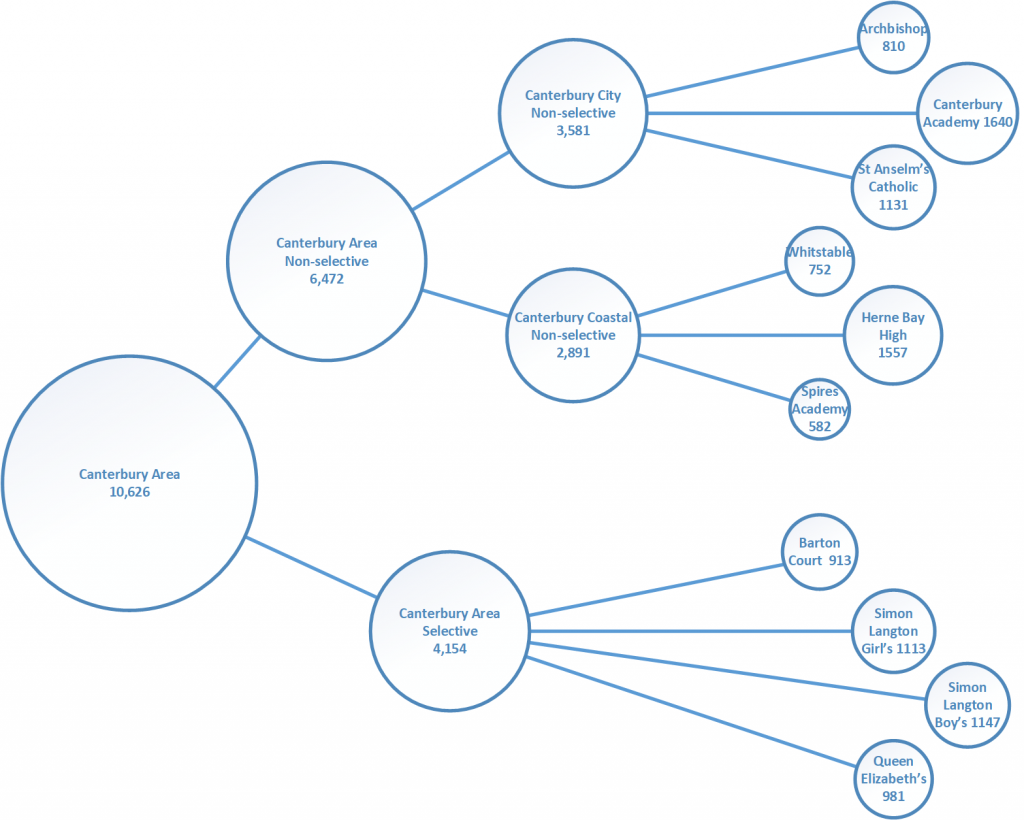
The surprise is that 39% of the children in the Canterbury area already attend a grammar school, over one and a half times the council’s target of 25%. This also shows there is very poor choice Canterbury City for parents seeking an inclusive secular education for their children.
The actual demand for places can be extrapolated from the table above by subtracting the surplus/deficit from the total published admissions numbers (PAN) for each planning area in the rightmost column. For example there are 530 places in the non-selective city schools and a predicted 2024-25 shortfall of -198 so demand is 530 – (- 198) =728. Demand for places peaks in 2023-24, so taking just the first, peak and last years’ values from the 5 year forecast we can add further columns to show actual demand for places then combine the two non-selective planning areas to arrive at the proportion of selective places in this forecast.
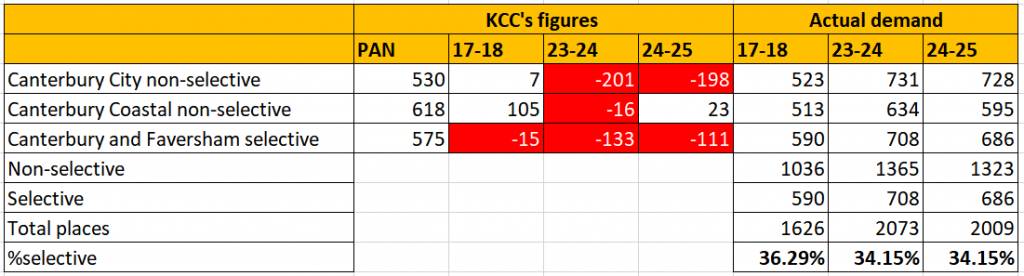
Kent County Council’s forecasted requirement for 133 grammar school places by 2023-24 is based one third of the places being selective even though their policy is for this to be 25%. If we rewrite this table from the ‘bottom up’, so that 25% of the capacity is satisfied with grammar school places it looks like this.
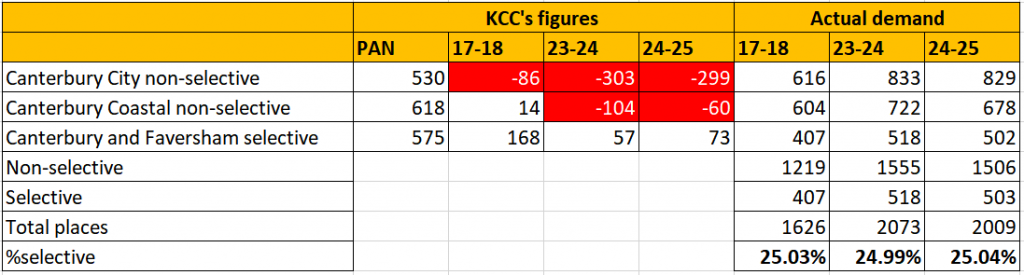
This now shows that with no expansion there is a shortfall of about 400 non-selective places but a surplus of selective places even at the peak period of demand 2023-24.
A circular argument?
This questions why KCC planners think the Canterbury area needs a further 150 places per year when the bubble diagram above shows almost 40% of the children in the area already attend grammar schools.
Maybe they’re trying to reflect parental choice. The problem with this approach is, if a policy aimed at admitting 25% of the cohort to grammar schools has already resulted in 40% then planning to admit 35% to grammar schools is likely to push that figure over 50%. That will in turn drive demand even further by parents who don’t want their children to be the ones who just miss out on a grammar school place wherever that line has been drawn.
An alternative suggestion
The KCC plan explains approval has been given to open a new 5FE (150 places) school on the site of the Chaucer Technology School which closed in 2014. They’d also like to expand Herne Bay by 1FE (30 places). Adding both of these to the 5-year demand forecast results in the following:
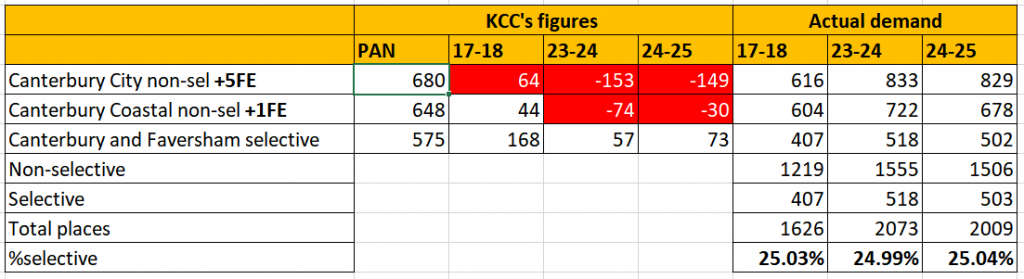
There still remains a requirement for a further 5FE school in Canterbury City as well as two forms in the coastal area which might be satisfied by expanding either Whitstable or Spires Academy. If Kent County Council follow their own policy of providing 25% places in grammar schools, they do not need an ‘annexe’ in the Canterbury area which would force children to travel to different towns once a week just so the primary legislation which outlaws the creation of new grammar schools can be subverted.
The above tables are available in this annotated spreadsheet.

0 Comments
2 Pingbacks