The term Secondary Modern dates back to the 1944 Education Act which streamed children based on of presumed different intellectual ability into different schools and so a de-facto definition of Secondary Moderns would be the other schools you get when you create grammars. As Sir Michael Wilshaw (2016) put it, “Every time you create a grammar school you create three secondary moderns” adding that no-one was queuing up to attend the latter. A negative perception the National Association of Secondary Moderns (NASM) are doing an excellent job of challenging.
The DfE recently added another field to the NPD defining secondary schools as one of the following three types
- Selective (163)
- Non-selective in highly selective area (225)
- Other non-selective (2,930)
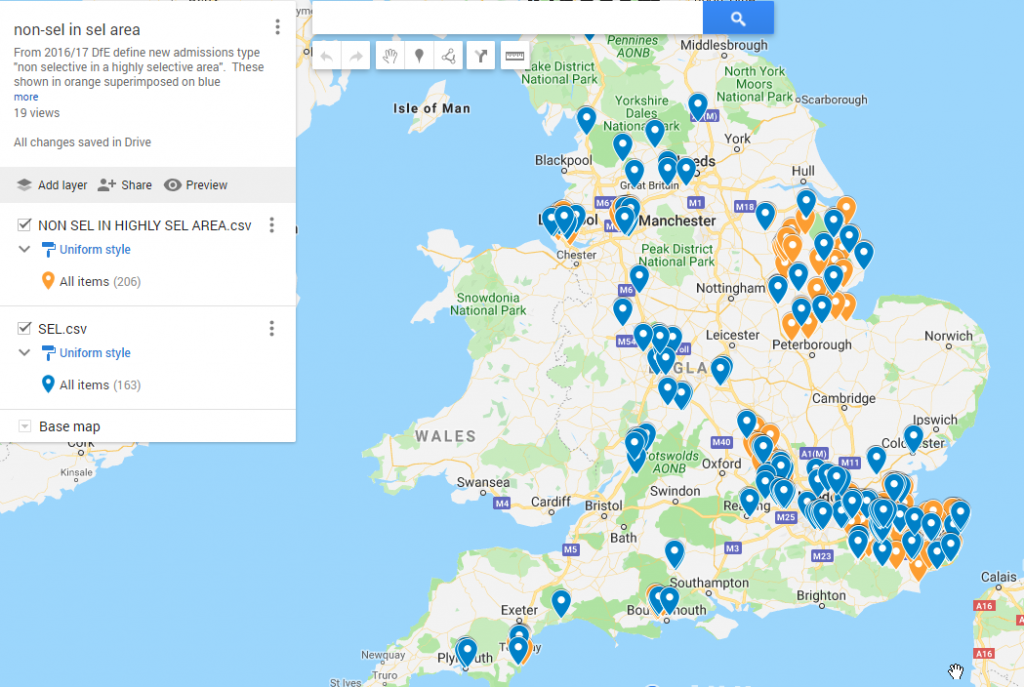
It’s says a lot about our policy maker’s obsessions with selection that the country’s 3,000 secondary schools are now defined in terms of their proximity to a handful of grammars. If the DfE must insist on using a euphemism to avoid describing what’s really occuring I’d rather they picked something which wasn’t quite such a mouthful. I’m just going to stick with calling them Secondary Moderns and stary by observing that plotting these on a map doesn’t present any surprises.
Becky Allen, Director of the Centre for Education Improvement Science at UCL, wrote an article (which I’d forgotten about when I first looked at this) asking When is a comprehensive school actually a secondary modern? She looked at both ‘recruitment neighbourhoods’ as well as prior attainment but still treated Secondary Modern as an absolute binary variable. A recent exchange of ideas with NASM (who the DfE would have us calling The National Association of non-selective schools who’ve found themselves next door to grammar schools) revealed that we both think that the definition of Secondary Moderns shouldn’t be binary. Some schools are more Secondary Modern than others which got me thinking about how you would go about defining them as a continuous variable.
Distance
The obvious starting point is distance because what makes a Secondary Modern is some of its children have gone to a nearby grammar school. Any areal based influnces reduce by the square of the ‘influencing’ neighbour’s distance so this should follow an inverse square law. Andrews et al (2016) found 90% of grammar school pupils in rural travelled 20km or less so it would seem sensible to exclude any grammars beyond a 20km radius as having any significant effect. The ‘influence’ is also directly proportionall to the number of places at the grammar so we could start by looking at the sum of all grammar school places within 20km, divided by the square of their distance:
(1) 
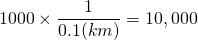
That gives a Secondary Modern-ness ‘score’ with a theoretical unlimited upper limit. For example, a non-selective school situated 100m from a grammar school which has 1000 pupils would have a Secondary Modern-ness score of
(2) 
To put this in to more readily understood terms we really want a range of values from (0%) where grammars have no effect to (100%) which is our ‘fully secondary modern‘. One way to do this would be to assume as the DfE have that Kent’s non-selective schools are all 100% Secondary Moderns, pick the lowest scoring of these as a constant k and dividing the result by this:
(3) 
What about ‘Super Selectives’?
The problem with this model is it doesn’t really work for super selectives; those isolated grammar schools which, because they’re not in fully selective counties, have been able to hoover up all the top prior attainment pupils from a really wide area. Over the years such schools have become ever increasingly selective at who they accept. Due to the lack of any regulation of entrance tests it’s hard to quantify how selective these schools are but compared to fully selective Kent, which aims to select the highest 25% attainers, Super Selectives might select only the top 5% from a catchment area five times as populous.
The town of Rugby has two grammars, Lawrence Sheffield and Rugby High School about 3km apart. Situated right in the middle of them is the Harris Church of England Academy.
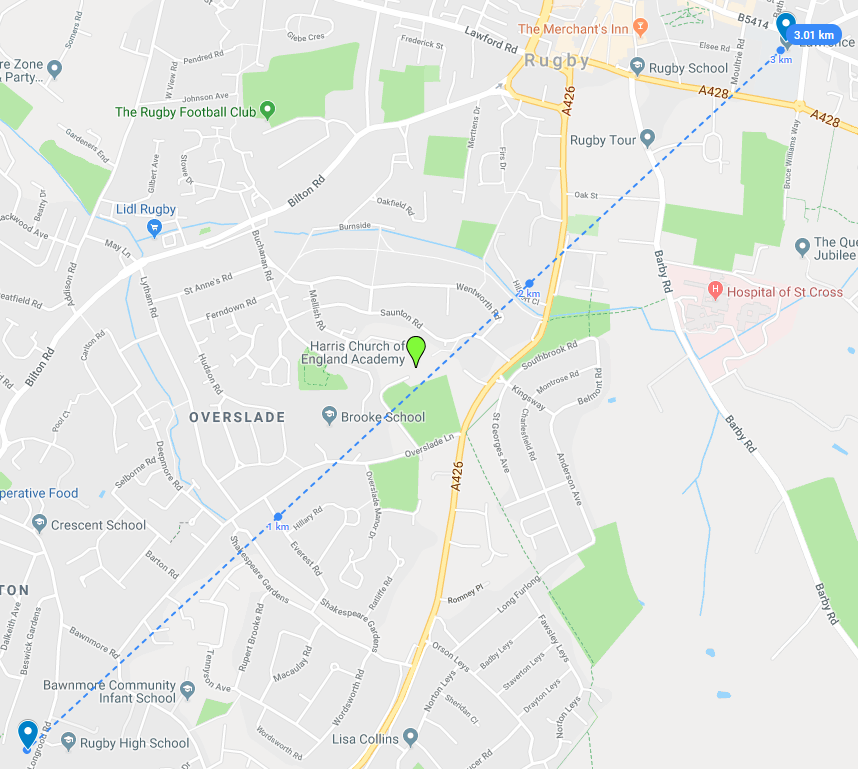
Based on formula (3) the Harris CoE Academy would be very Secondary Modern but the impact of the two grammars on this school actually depends on their admissions policies. To understand that we’re in the realm of unstructured data, searching out and decoding the individual admissions arrangements for the country’s 163 grammar schools!
A far more practical approach is to examine the data empirically to discover how far children are travelling to the grammar schools and include that as  to the formula
(4) 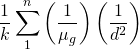
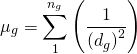
This mean travelling distance in equation (4) is also subject to an inverse square law based on the individual distances  each grammar school child travels so this ‘distance’ for the grammar school can be defined as:
(5) 
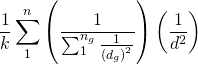
Substituting (5) into (4) we get
(6) 
This model is still not ideal
- Rural pupils travel further than those in urban areas
- The model lassumes the ‘grammar school effect’ is radial which wouldn’t be the case if it was on the edge of a built up area or even more a coastal town. Not many pupils live in the sea!
These could be added to the model as final refinement although that’s probaby best left until working with actual data. Having found a definition of Secondary Modern this can then be used as the explanatory variable in linear regression model to see what effects there are on KS2APS, progress and better inform the public debate over how academic selection and faith is used in the school admissions process.

The expansion of Grammar Schools in Trafford thanks to a dollop of the £50m bung
from Damian Hinds, will have profound impacts on the finances,intake and ultimate viability of the Secondary Moderns. Budgets will have to be cut as the Grammars “target” high achieving pupils eligible for pupil premium. As though the current 11+ is
Not perverse enough depressing the expectations and aspiration of children,families,
and whole communities it will now have a second wave of unfairness! We already know the 11+ is flawed, damages social mobility and damages self esteem. We also know recent analysis that current Progress 8 measures neither take account of disadvantaged intakes but fails to accurately reflect school performance. We need a radical change. A National Education Service, properly funded, with transparent measures of accountability with democratic local accountability