Equality in Education

Category: Uncategorised (Page 3 of 4)

Can o’ worms

Following Louise Tickle’s piece in the Guardian, there has been widespread speculation regarding my motivation for wanting 11+ test marks to be made public.  Contrary to some speculation, I am not trying to get my 16 year old son into year 7 at the local grammar. That would be silly.

This is purely about whether information should or should not be disclosed.

Why is this important?

To understand why releasing the information is important requires an understanding of standardisation although ironically, if the information was released everything would be crystal clear.

As any statistician will explain, a standardised score measures the individual relative to the population.  What 11+ providers don’t tell you is, behind the scenes, they interpret population as just one year’s cohort.  Given a set of test marks, a desired pass mark and the proportion needed “pass” in order to fill the school, it takes less than half an hour to ensure your grammar school standard selects the correct number of applicants to the exact child.  To me it is deceptive to refer to something as standardised when it is anything but.  However, given the amount of trouble I’ve had explaining this I made a five-minute film explaining it the issues.

Click on Snow White, all will be revealed and you’ll only be five minutes older.

Public Interest

The Freedom of Information Act operates on the principle that information should be disclosed unless there is a reason not to.  In this case Durham have said that release of this information would be commercially damaging.  The court now need to decided whether overall, it is in the public interest for the information to be released.

There is some confusion about what constitutes public interest.  Whilst the public are probably quite interested in how much Manchester United paid for Cristiano Ronaldo it’s not in the public interest in the same way that it would be useful to understand what exiting the EU actually means.  In the same way, an individual parent knowing why their child did/n’t get offered a place at a given school isn’t in the public interest in the same way that knowing how schools admissions operate in general.  There follows a few reasons why disclosure of this information is in the public interest.

Reasons for Disclosure

If there is a downturn in overall admissions numbers then, like the self-levelling suspension on those funny old Citroëns, grammar school standard is automatically lowered. That’s good for the grammars as they remain full and therefore fully funded but no school is an island. In Kent, which is fully selective, this must come from taking pupils who in other years would have attended the neighbouring secondary moderns.  Those schools are faced with dwindling numbers and loss of funding.  The heads can’t complain about moving goal posts because they don’t even get to see the goal posts (raw marks).

The law states, “Admission authorities must ensure that their arrangements will not disadvantage unfairly, either directly or indirectly, a child from a particular social or racial group.”  GLA have told the Schools Adjudicator that Verbal Reasoning tests are biased against EFL children so it would be in the public interest to understand what weighting each authority gives to each discipline (Maths, Verbal Reasoning, Non-Verbal Reasoning).  That way any particular social or racial group who may feel they are unfairly prejudiced can challenge these arrangements but these groups don’t get to see the goal posts either.

Reading School’s 2015 entry set a cut-off mark of 110.  The standardised results show that one boy scored 110.00 whilst another only 109.99.  To quote the school’s published admissions criteria the second was, “deemed not to benefit from the style of education provided at Reading School.”  It continues, “The following criterion will be used to allocate places as between borderline candidates who cannot be distinguished in terms of academic ability.  With regard to the historic links with the Borough of Reading, eligible boys living nearer to the School will be accorded a higher priority in the allocation of day-boy places.”  This tie-breaker has never been used!!  If a child in Newbury scores 0.01 higher than one in Newtown he’s given the place.  Data from North York, where children sit two tests a week apart show the residual variance (‘noise’) is about 20 – 30% so a 95% confidence limit would put the true scores of these test takers somewhere in a band of about 20 marks, but the results are recorded to two decimal places!  It’s in the public interest to understand that this ‘distinction’ is entirely synthetic so they can question the decisions made by what is an increasing number of unaccountable governing boards of Academies who have been given the power to act as their own admissions authorities.  Admissions law says, ‘Parents should be able to look at a set of arrangements and understand easily how places for that school will be allocated’ but the basis on which schools are currently ‘distinguishing’ between candidates is completely hidden.

When the location of the itinerant goal posts is a closely guarded secret, there isn’t much incentive for the referee to pay attention.  One school ‘standardised’ six candidates, who sat a late test, as an entirely separate population.  As standardisation selects a proportion of the population regardless of absolute attainment, this blunder guaranteed two of these candidates a place.  The candidate originally ranked 100th (for 100 places) in the main test scored 113/150 but was pushed down two places by applicants with raw scores of 87/150 and 76/150.  Standardisation might come across as a bit of a black art but if you check the raw marks, this gaffe stands out like a sore thumb.  This information was not released until the First Tier Tribunal ordered it but if it had been routinely released the parents of the two children who missed out on a place as a result would have had no trouble whatsoever picking up on the mistake.

The 2016 standardised scores for Bucks county included some negative scores.  Durham explained this was the result of, “… adjusting the standard deviation to account for a fixed qualifying score of 121 and a year-on-year increase in the number of candidates.”  If that’s not moving goal posts I don’t know what is.  The scores for the 2016 Verbal Reasoning test consisted of over six thousand different standardised scores.  I’d like to understand how slightly over a half an hour’s multiple choice questions can differentiate candidates to such a degree.  I can conceive some particularly ingenious mathematical ways to generate such arbitrary precision but it’s about as smart as making a sundial so big you are able to read the time to the nearest second.  (Who needs a space elevator when you have a Durham ™ sundial?)

There is also that claim floating around that Durham have somehow managed to invent a test which can’t be tutored.  In Coombs vs ICO (2016)  Judge Hamilton considered, “… the appellant had provided evidence that the claimed USP of tutorproofing was highly questionable and that the public interest warranted close examination of this claim which could only be achieved through the disclosure of the disputed material.”  So at least one Tribunal judge thinks that it would be in the greater interest to be able to challenge such a claim.

There is general public interest in public authorities being transparent in their decision making.  Durham’s income from the 11+ in 2016 was £815,801 but this is only part of the picture.  These tests are used to decide which children benefit by attending one of 163 grammar schools.  Estimating their the annual budget as £5m per school, the best part of a billion pounds of public funding each year depends on the outcome of 11+ tests.  Transparency specifically over whether the allocation of school places is based on sound decision making is in the public interest.

Reasons for non-disclosure

Having listed a few reasons why it would be beneficial to release the information it’s important to put the other side of the arguments.  The reasons the Information Commissioner gave for non-disclosure are:

  1. It is in the public interest to develop tutor proof tests.
  2. The Information Commissioner says that CEM’s rival is not subject to Freedom of Information thus placing CEM at a commercial disadvantage.
  3. The revenue from these tests helps fund Durham Vice Chancellor’s £470,000 basic salary.

Regarding the first of these points, the Commons Select Committee of Education found, “the Government has yet to demonstrate how an admissions system could be designed in a manner which would be immune to gaming, or down to the ability to pay.” Giving evidence, the Chief Scientific Advisor for Education Tim Leunig said, “Buckinghamshire had attempted to come up with one [a tutor-proof test] but it had not worked.” and schools minister Nick Gibb has likened this objective to the quest for the holy grail.

Regarding the second, GLA are indeed a private company, but the information itself is held by schools.  If, for example, I thought GLA were selling tutor proof tests or snake oil I’d ask the schools for information.

With the last point the Information Commissioner’s exact words put a bit more lipstick on this particular pig but still boils down to not releasing information because Durham are making money from something.  Exactly what, has me confused.  Each time I mentioned “tutor proof tests” during the hearing I was reprimanded by the judge who tells me Durham’s unique selling point is that their tests are seen to be more resistant to tutoring and that it works hard to design tests that are as resistant to tutoring as possible.  C’mon that’s one hell of a mouthful!

The hearing lasted about six hours without even managing to establish that commercial damage would result from the release of the information.  As we seemed to be in total deadlock over this point I thought it worth conceding so we can get on to the question of which is most important; Durham’s profits or opening up the can of worms.

Lies, damned lies and the Tory manifesto on Education

To quote Mark Twain, There are three kinds of lies: lies, damned lies, and statistics. Perhaps it’s time to replace the last of these with political manifestos.

In April the government opened some rather mundane consultation on the way they capture educational outcomes of pupils according to income group. The report included the somewhat redundant observation, The percentage of children at selective schools from below median income families, who are not considered disadvantaged, (36%) is almost the same as the percentage for non-selective schools (35%).

True enough the yellow bars are about the same length although in the context of understanding social mobility it’s their position which is really relevant.  This was no big deal in the original report because it was one of a number of neutrally stated facts given in context and the above graph makes it abundantly clear that the grammar school system is prejudiced against disadvantaged children.

What is a lie?

To transform this factual DfE into a lie the Tories stripped away data which the DfE described as key; disadvantaged children and those from above median income families then come up with a totally meaningless label, ‘ordinary working class’.  Just when you think they could stoop no lower in quoting official statistics completely out of context, the Tory manifesto.  Page 52 says, Contrary to what some people allege, official research shows that slightly more children from ordinary, working class families attend selective schools as a percentage of the school intake compared to nonselective schools.

Coming from a writer doing their utmost to decieve the reader that’s a bit rich and it’s hard to see how Teresa May could be more manipulatively deceptive in her dogmatic pursuit of reintroducing grammar schools but then, lying to the public in the lead up to elections now seems to be the accepted norm.

A while back I signed a petition proposing the creation of an Office of Electoral Integrity but I can’t really see politicians ever countenancing something which curtails their ability to wantonly deceive the public for political gain.  I’m going to have to rely on the tried and tested way of telling when they stop lying; observing when their lips stop moving.

Effects of tutoring on the 11+

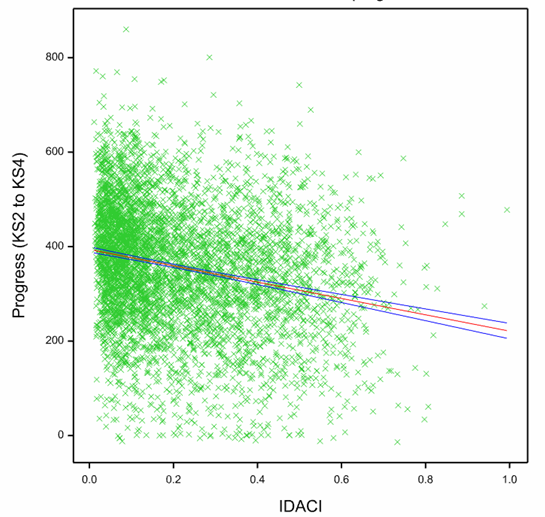
This paper investigates the hypothesis that if children are intensely tutored to do well in the 11+ this also likely boosts their KS2 SATs results. If pressure is then eased after they entry to selective secondary schools that might manifest itself in lower KS2 to KS4 progress than would otherwise be expected.

There is no data to indicate which individual students are tutored. The study used IDACI (Income Deprivation Affecting Children Index) as a proxy and found a statistically significant relationship between this an progress. More affluent children progress less between KS2 and KS4.

The research was not peer reviewed but Dr Leunig, chief scientific advisor at the DfE drew comparisons with Rodeir Zanini’s observations (2015) that whilst A-level results were good predictors of university degree classifications students from private schools didn’t do quite as well as their A-Level results would suggest. In both scenarios, teaching to the test shows short term gains.

Recommendations

  • Control of admissions policies should be moved from schools to independent external bodies to remove the conflict of interests which currently exists
  • Given these tests are used to decide the educational futures of
    hundreds of thousands of children each year they should be
    regulated and standardised
  • 11+ test results should be included in the National Pupil Database
    so they are available to researchers
  • Proper trials into the effect of tutoring should be commissioned by
    the Department for Education
  • Given these are ‘high stakes’ tests independent research should also
    be conducted into other potential prejudices the tests may display
    such as towards EAL and dyslexic pupils.
  • If grammar school admissions were centralised an empirical method
    of ‘poverty weighting’ could be introduced but serious consideration
    would need to be given to how such a system could avoid being
    abused.
  • The DfE should investigate why one quarter of the IDACI data for
    selective school pupils is missing from the autumn 2015 Census

The full paper can be downloaded here.

Citation

Vidal Rodeiro, C., & Zanini, N. (2015). The role of the A* grade at A level as a predictor of university performance in the United Kingdom. Oxford Review of Education, 41(5), 647–670. https://www.tandfonline.com/doi/full/10.1080/03054985.2015.1090967

GL Assessment, “11+ tests disadvantage dyslexics and EAL”

The Schools Adjudicator asked Altrincham Boys Grammar School (ABGS) to provide assurances that their 11+ tests don’t disadvantage children with special educational needs (SEN) or those who spoke English as a second language (EAL).  ABGS asked the examiners, GL Assessment to provide a report for the Adjudicator which they refused release to the public.  The report was eventually released six months later by the Adjudicator.

With regard to non-native English speakers it found, “EAL candidates will, on average, perform less well than non-EAL candidates on the same test.”  With regard to dyslexia, GLA state, “There may be cases where the nature of testing and the means of carrying out make it inappropriate entirely for the candidate.” that “each case should be individually assessed” (their emphasis) and that “it may not be possible to establish for certain that the special arrangements [extra time] perfectly compensate for the nature and extent of the disadvantage.”

GLA concluded that whilst the tests might prejudice SEN and EAL applicants the choice of test is the responsibility of the admissions authority.  85% of selective schools have converted to Academy status so act as their own admission authority with no external oversight from the elected Local Authority.

The Schools Admissions Code, the legislative framework under which admissions to state funded schools must operate, specifically states (§1.8) ‘Admission authorities must ensure that their arrangements will not disadvantage unfairly, either directly or indirectly, a child from a particular social or racial group, or a child with a disability or special educational needs.’

Will poorer families benefit from the return of Grammar Schools?

On Monday the outgoing chief Ofsted inspector Sir Michael Wilshaw said, “The notion that the poor stand to benefit from the return of grammar schools strikes me as quite palpable tosh and nonsense” (gov.uk, Sept 2015).  In a House of Lords debate, Lord Nash responded by saying, “there is no clear evidence to support his views” (Hansard, Sept 2015).  So who is correct, Wilshaw or Nash?

Every grammar school can provide anecdotal evidence of alumni who came from humble origins but went on to achieve great things thanks to the schooling they received but the real questions which need answering are, whether such opportunities are available equally to children from all socioeconomic backgrounds and whether selective admissions policies prejudice those on lower incomes.

Unless it’s also being argued that there is a link between wealth and intelligence then there should be no significant difference in the socioeconomic profiles of both selective and non-selective schools.  The evidence not only shows Wilshaw was completely justified in dismissing claims that grammar schools promote social mobility but also that selective admission policies, per se, appear to be incompatible with the legal requirements to ensure that admissions our publicly funded schools do not disadvantage unfairly, either directly or indirectly, a child from a particular social or racial group.

FSM or IDACI

Most studies use free school meals (FSM) as an indication of income however this only provides a single measurement point.  Since 2008 the National Pupil Database has included a specific socio-economic indicator called the Income Deprivation Affecting Children Index (IDACI) listing the probability, ranging from 0 to 100%, that a child is living in poverty.

To compare the profiles of selective and non-selective admissions policies, over half a million individual pupil records were taken from the 2014/15 census and the proportion of these falling in each 5% range of IDACI scores was calculated then plotted.

2015-compare

Both distributions are skewed to the right because the numbers of children decreases as poverty levels reach 100% but the grammar school values, shown in pink, are far more skewed.  Selective schools admit twice as many children in the leftmost, most affluent, IDACI band when compared to non-selective schools.  Wilshaw previously said grammar schools are, “stuffed full of middle class kids” (OECD 2013) and if we define middle class as those living in areas of 10% or less poverty then the graph demonstrates that this happens at the expense of those living in areas between 20 – 70% poverty where the blue, non-selective, bars are all far higher than the grammars.

Selective schools don’t purposely set out to discriminate so we need to understand why their admission processes are so biased against children from poorer backgrounds.  There may be a number of contributory factors such as the cost of commuting long distances or schools pressuring parents to make donations but the one factor they all have in common is children are selected through an entrance test.  It’s very hard to see how a couple of hours’ of multiple choice questions can ever be capable of providing a reliable and accurate measure of an individual’s aptitude and the obvious explanation for children from wealthy families being more successful in grammar school tests is they have been tutored to pass them.

For many decades the tobacco industry argued that a correlation between smoking and lung cancer didn’t prove causality.  There is dearth of objective research into the effect of tutoring however the circumstantial evidence, in the form of a thriving cottage industry in tutoring, is overwhelming.  Parents are clearly in no doubt whatsoever that tutoring increases the chance of their child getting a place.  CEM who provide about half the 11+ tests have withdrawn promotional material suggesting their tests are resistant to tutoring and recently stated, “Without extensive and expensive research, it is not possible to quantify the impact of coaching on the results from our tests.”  The test providers are best placed to carry out any research into the effects of tutoring but like the tobacco industry before them, have no incentive to undertake research which would threaten the millions of pounds they currently earn each year from administering the tests.

‘Parental Choice’ will always be the preserve of who can afford it, whether through buying a house in the right area, paying to send a child long distances to attend a school or tutoring to pass a test but the evidence here is conclusive and quantifiable; selective schools are systematically disadvantaging children who live in areas of 20% poverty and above.

Acknowledgements.

I am very grateful to National Pupil Database team for their help and guidance in applying to use and providing their data.

About the data

The data were taken from the KS4 Pupil 2015 data linked to KS2 Autumn Census 2014/15.

The Selective schools dataset consisted of 22,474 individual pupil records which matched KS4_ADMPOL=2 (selective schools).

The non-selective dataset consisted of 519,521 individual pupil records which matched either KS4_ADMPOL=1 (comprehensive) or KS4_ADMPOL=3 (Secondary Modern).

Citations

Wilshaw M, 5 Sept 2016, Speech at the London Councils education summit. Published on gov.uk website https://www.gov.uk/government/speeches/sir-michael-wilshaws-speech-at-the-london-councils-education-summit

Nash J, 8 Sept 2016, Debate in House of Lords.  Published on www.parliament.uk website http://hansard.parliament.uk/Lords/2016-09-07/debates/16090727000539/GrammarSchools

Crawford C and Greaves, E, 2013, A comparison of commonly used socio-economic indicators: their relationship to educational disadvantage and relevance to Teach First.  The Institute for Fiscal Studies, London.  http://www.ifs.org.uk/comms/r79.pdf


Proposed annexation of Devon

The Rt Hon Nicky Morgan
Education Secretary
The Government
London

13 May 2016

Dear Nicky Morgan,

Following the announcement that the Weald of Kent grammar school will be opening an annexe in Sevenoaks, I’m delighted about the additional choice this will provide to Sevenoaks parents who can afford the tutoring needed to pass the entry test. Obviously it’ll be better when they start admitting boys but it’s a start. The thing is though, Kent already has loads of grammar schools. The Institute of Fiscal Studies (2013) say 28.4% of Kent’s school places are in selective schools and, for those than can afford it, public transport means you don’t even need to live in a grammar school town.

My concern is Devon where only 1.7% of the state funded places are grammar schools. There are a huge number of Tory voters who are currently forced to send their children to a school where they’re obliged to mix in with the lower classes. I think the way you’ve side-stepped legislation banning the creation of new grammar schools in Kent should be extended to provide desperately needed selective places in Devon which right now provides virtually the same opportunities across all social status groups. It’s almost socialism!

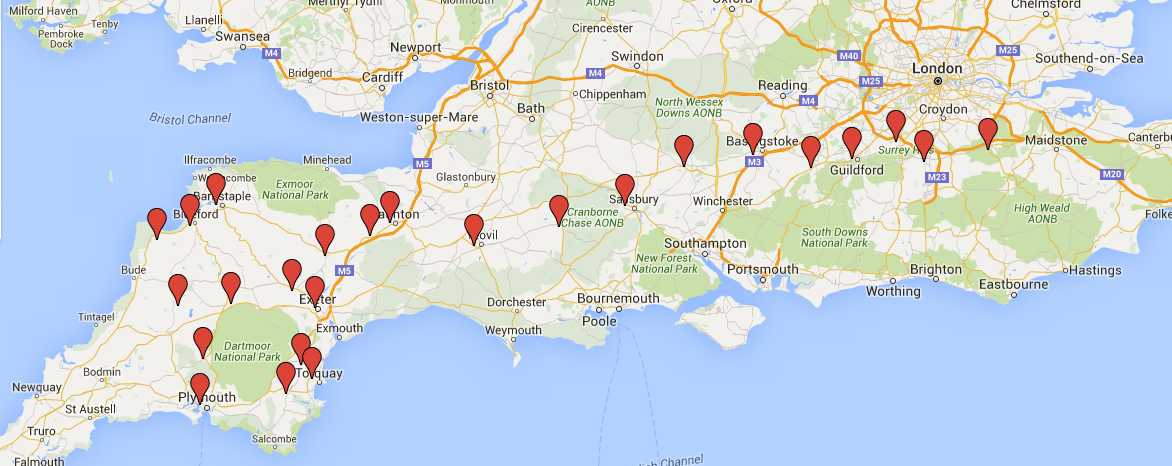
My proposal is that the Sevenoaks annex opens an annex in Redhill, then Redhill opens an annex in Leatherhead, then Leatherhead opens an annex in Guildford, then Guildford opens an annex in Farnham, then Farnham opens an annex in Basingstoke, then Basingstoke opens an annex in Andover, then Andover opens an annex in Salisbury, then Salisbury opens an annex in Shaftesbury, then Shaftesbury opens an annex in Yeovil then Yeovil opens an annex in Taunton then Taunton opens an annex in Wellington then Wellington opens an annex in Tiverton.

Proposed anschluß annexation of Devon

Proposed anschluß annexation of Devon

Having established Tiverton as a beachhead the rest of the county can be annexed with two main incursions of serial annexations, one pushing to the south through Exeter, Newton Abbot, Torbay, Totnes, Plymouth and Tavistock and the other taking a more northerly route incorporating Crediton, Oakhampton, Ashwater, Woolfardisworth (just because it’s got a funny sounding name) Bideford and Barnstable. Other than the national parks, which are mainly inhabited by sheep, this should pretty much cover the county.

The lack of an upper tier of state funded education facilities in Devon is an absolute disgrace when compared to other parts of the country and I would be very grateful if your department gave serious consideration to this or other ways to redress the current imbalance.
Yours sincerely
James Coombs
References:
Cribb J et al, 2013, Entry into Grammar Schools in England, The Institute for Fiscal Studies http://www.ifs.org.uk/docs/Grammar_Schools2013.pdf.

Einstein on SATs

Einstein* captured the issue in a single sentence.  “Sometimes what counts can’t be counted, and what can be counted doesn’t count.”  With Maths in particular it’s possible to get very good marks in standardised tests just by applying various methods without the need to engage in any deeper thinking/learning such as why does this work.  For other subjects, substitute mathematical methods for historical facts or a tick list of grammatical idioms the examiner will be looking for.  Being able to churn out a drop in clause, just for the sake of it, doesn’t make me a good writer.

Our current education system was designed by the Victorians to produce convergent thinking production line workers in the days when a ‘computer’ was a job description and there was a real need for a consistent thinking workforce.  The SATs tests themselves are inherently OK.  The problems arise from the current political obsession for ‘raising standards‘ by blindly applying the McKinsey Maxim: “What you can measure you can manage.” without pausing to consider what standardisation actually means.

Michael Armstrong (1999) explained, “a standard is a measure… but the most dynamic characteristic of learning, which for want of a better term I will call its creative aspect, cannot be measured…  Moreover, a standard is a measure of conformity whereas education is as much, if not more, concerned with non-conformity: with exception rather than rule; with the novel, the unexpected, the re-described and re-constructed; with the revival of learning no less than its transmission, and with innovation as well as tradition.”

production-line

A very standard looking workforce

This focus on standards worked well in the C19th producing a consistent workforce needed for the industrialised production lines but for the C21st we need innovation and creativity in order to prosper as a nation.

Einstein or McKinsey? Who should guide education policy?  One of the greatest thinkers the world has ever known or a bunch of accountants?

*According to Quote Investigator, who appear to have researched this rather well this wonderful chiasmus should be attributed to William Bruce Cameron, citing his 1963 text “Informal Sociology: A Casual Introduction to Sociological Thinking”.  I didn’t discover this until some time after writing the blog.

References

Armstrong, M. (1999) ‘The Quality of Learning’, in O’Hagan, B. (ed) Modern Educational Myths: the future of democratic comprehensive education.  London: Kogan Page Limited, pp.109-120

Schools Adjudicator to ban complaints from campaign groups

I am a proscribed organisation.

I wasn’t even aware of the fact until I read Fiona Millar’s article for Guardian, School admissions, the dodgy practices need to stop.   Schools Adjudicator Dr Elizabeth Passmore has recommendation that ‘campaign groups’ should be prevented from referring objections to her office.  As Ms Millar rightly points out, “What matters is whether the school is acting unlawfully, not who makes the complaint, especially as it is a time-consuming and technical process that is not easy for the average parent.”  This announcement by the Chief Schools Adjudicator certainly explains the way her office handled my objections to Reading and Kendrick schools’ admissions.  Ms Millar asked me to recount my recent experiences of dealing with consultation and the Schools Adjudicator through the Local Schools Network website which I reproduce here.

The schools’ approach to public consultation has traditionally been to add the word ‘proposed’ to the admissions page of their website and make some passing remark about inviting comments, hoping that no-one would actually notice. My response was to create this website encouraging comments from all perspectives, to write to all the local primary heads asking them to alert parents, to contact the local media and give interviews to BBC Radio Berks and South Today. Basically anything I could do to promote awareness and bring this important topic out into the open where it belongs.

Subsequently I referred matters to the School Adjudicator whose determinations seemed incredibly biased disregarding any rational objective arguments I was making.   I don’t have the sort of deep pockets needed to fund a judicial review so it stopped there. It’s only now, following the recent press coverage, that I realise that I fit the OSA’s profile of being a proscribed organisation. Can someone tell me where to get the balaclava and, for the Molotov cocktails is it best to use vodka or gin?

“Consultation”

The most concerning point, buried deep in those rulings, was the adjudicator concluded that schools did not need to consider changes proposed during the consultation period because, by the time these were raised, there would be insufficient time to consider them. (See Reading §24, Kendrick §22.) The corollary being, since they’re the only ones who can decide on what to ‘propose’ in the first place, only the unelected school governors are in a position to make any changes. Why do we have a process of consultation at all if all it serves is to rubber stamp a foregone conclusion?

Reading and Kendrick’s preference for an applicant from affluent but remote Newbury over poor but nearby Newtown if the former scores just 0.01 of a ‘standardised’ mark more doesn’t exactly make them the ‘heart of the community’ and during the consultation 600 people signed a petition requesting fairly moderate changes; that some of the places go to local children who were of ‘grammar school standard’. In response to requests to discuss this, the schools explained they don’t actually meet with people during ‘consultation’ and it wasn’t until four days before the end of the consultation period that they defined the scope, saying it was limited to minor changes to the over-subscription criteria. Hard to see the goal posts when they’re moving so fast. The schools determined to carry on pretty much as they have done since the Greenwich ruling, selecting as high a standard as possible from as far afield as possible.

But if you think that sounds like a despotic and dictatorial way for a publicly funded body to go about business, Dr Passmore’s annual report (§50) makes it crystal clear that this is all perfectly acceptable, “the school needs to show that it has considered the responses and then having considered them decided whether to change the arrangements or not”.

I can imagine Dr Passmore briefing Nicky Morgan, “Yes minister; the system is fool-proof. As long as they record it in the minutes the school governors can do whatever they like, the public feel like they’re being fully involved and should anyone be so rash as to propose any actual changes the authority can point out there is not enough time to consult on them.“

nicky-morgan-yes-minister

Promoting social mobility

Grammar schools select from as wide an area as they can possibly get away with because that is a dead cert way to ensure good GCSE results for the school. It works too. Every year the BBC tell us that Reading and Kendrick are in the “top 10” because the Beeb haven’t yet spotted the blatantly obvious correlation between attainment at age 10 and attainment at age 16. Although not ideal, Value Add ratings have been around since the late 1990s but the mainstream press persist in telling us which schools are ‘best’ based on final GCSEs. Instead the media should be telling us that Reading, Kendrick and all those other ‘top’ schools are really the most selective in the country and I’ve started a petition to ask them to start reporting on which schools are improving educational outcomes instead

It’s commonly accepted that excessive tutoring by the middle class has hijacked any benefits selective education may once have provided but I didn’t argue that point because to do so objectively first requires parents to come clean about all that tutoring. Instead I went for an irrefutable fact – the price of a child season ticket from Slough to Reading is getting on for £1000. Ergo, any school which admits pupils from a wide geographic area is automatically discriminating against those on low incomes. Reading School told the Adjudicator that children on pupil premium are able to claim the cost of travel leaving it to me to fill in the gaps; Local Authorities are only legally obliged to provide such assistance, “to the nearest suitable school”.

I also pointed out the fact that 0.5% of the schools’ pupils are in receipt of pupil premium, shockingly low even by grammar school standards. The adjudicator disregarded rational evidence based arguments concluding the overall policy was not discriminatory because the schools gave priority for pupil premium applicants. So it’s official. Reading’s grammar schools welcome children of all social backgrounds from Slough, Newbury, Basingstoke etc. with open arms … but obviously only those who can afford the travel. The only type of mobility they’re promoting involves an internal combustion engine. I was fully aware I was challenging the entire system but I didn’t realise that having a blog and organising a curry night made me a fanatic revolutionary in the eyes of the authorities.

Wholly or mainly

Both schools’ funding agreements say, “the school will be at the heart of its community …” and, “the school provides education for pupils who are wholly or mainly drawn from the area in which the school is situated”. This is a requirement of Section 1(6) of the Academies Act 2010 which you’d really expect to apply equally to all academies but the average travelling distance for Reading and Kendrick pupils is up to 8 times that of the town’s academy comprehensives.

googlemap2

The Adjudicator was satisfied that, once the neighbouring borough of Wokingham had been included into the definition of “the area” that over half the pupils came from within it. As far as I’m aware there have been no legal rulings defining the interpretation of the 2010 Academies Act but I can’t help thinking that if the legislators wanted to ensure that “over half” the pupils came from the area they’d have used the words “over half” and not “wholly or mainly”.

Open and Transparent?

11+ results are ‘standardised’ the only purpose of which seems to be obscure what’s really going on. Don’t get me wrong, done properly, the statistical process of standardisation allows you to place where an individual is relative to the population. But the Grammar schools have morphed a sound statistical process into something rather unique which they call ‘local standardisation’. Surely it’s an oxymoron to describe something as both localised and standardised at the same time. Any text book on statistics says standardisation is relative to the population and this population should be as large and representative as possible but ‘local standardisation’ only compares applicants against each other. Very convenient if you want to ensure the school gets good GCSE results, disguise any gradual long term inflation in ‘grammar school standard’ and prevent any comparison between schools.

“Admission authorities must ensure that the practices and the criteria used to decide the allocation of school places are fair, clear and objective.” (Schools Admissions Code). Reading School’s admissions criteria explains, “A cut-off point will be determined, below which students will be deemed not to benefit from the style of education provided at Reading School”, but thanks to ‘local standardisation’ the definition of whether an applicant is ‘suitable’ actually depends on who else the school can persuade to sit the test.

Over the years, so called super selection creates a feedback loop which goes like this. Selective schools get good GCSE results. Based on these results the BBC say they’re the best schools. More parents want to enter their children. ‘Local standardisation’ allows entry levels to covertly rise whilst giving the appearance that the pass mark isn’t changing. The school get even better GCSE results. The BBC say they’re even more wonderful. Even more parents want to enter their children …

super-selective

Both CEM and GL explain that standardisation should be carried out against as wide and representative a population as possible. They have the data. They have the experience. They even have a copy of Excel, so why are 11+ tests ‘locally standardised’ unlike any other psychometric or academic test you can think of? The Adjudicator said he was satisfied that, “by contracting with a test supplier with a long history of assessing children for various purposes the school has met the requirements”. Would he have been equally satisfied to send his children to a child minder with a long history of various types of abuse? The question I’d raised was not over CEM’s competency but their intent. They earn over £1m each year from 11+ tests and persuaded the Information Commissioner that it was against their commercial interest to reveal even the raw marks from the tests as this would undermine their unique selling point (USP) of providing tutor proof tests.

The Commissioner’s decision is currently under appeal but CEM were not even prepared to disclose why they thought commercial interests would be damaged until they were ordered to by the court in this last week. This revealed they’d put two arguments to the Commissioner. Firstly, that other companies might emulate their tests but they went on to say this is already happening. Secondly they said, “If a precedence was set in this case then the data for each of our tests would be requested, for each and every year we develop the tests. This would provide a comprehensive history of our test development.” Withholding the marks of the test has nothing to do with protecting the development of questions and everything to do with preventing disclosure of the fact that the so called ‘grammar school standard’ is not in any common sense of the word ‘standard’ and has been inflated year on year so that grammar schools can get good results with the minimum of effort and they’re the ones paying CEM £1m each year.

Responsibility

In her annual report Dr Passmore says, “Too often own admission authority schools seemed to think that putting their proposed arrangements on the school’s website was sufficient and they made no attempt to inform the relevant parties that a consultation was taking place.” She continues, “A common shortcoming by admission authorities of secondary schools is to notify primary schools about their consultation and assume these schools will in turn inform the parents of children attending their school. Unless a primary school has been asked to pass information to its parents and agrees to do so the secondary school is not meeting the requirement to consult the parents of children in the primary age range, and is certainly not consulting those from age two upwards.”

Reading and Kendrick Schools said they’d delegated responsibility for consultation to the LA. The LA said they’d asked primary schools to advise parents of consultations through newsletters but although Kendrick School claim to have carried out full consultation every year since 2008, during which time my children attended a primary school a few blocks away, I have never once seen a letter alerting me to these ‘consultations’.

On this point it would have been good to see the Adjudicator following his own guidance instead of dismissing all of the concerns I raised simply because I’ve challenged the bigger picture. Dr Passmore’s annual report calls for organised groups like me to be prevented from raising objections in the first place but this really isn’t necessary as her office have already unilaterally implemented a de facto policy of dismissing objections from anyone who challenges the status quo.

“wholly or mainly …”

The Academies Act 2010 mandates that Academy schools, “provide education for pupils who are wholly or mainly drawn from the area in which the school is situated.”  To see how that works for Reading’s seven Academy secondary schools here’s an interactive map file showing where each school’s pupils come from.  Click the icon in the top right hand to ‘view larger map’ full screen and this will let you toggle on/off each school.

(Note – to safeguard privacy we requested only postal sectors which contain on average 2,600 households. These were then converted to a random full post code. For example, the pupil living somewhere in OX11 9 offered a place at Reading School has been randomly assigned the full post code of OX1 19AF.)

« Older posts Newer posts »

© 2026 TRAK

Theme by Anders Norén — Up ↑

Creative Commons License
Except where otherwise noted, the content on this site is licensed under a Creative Commons Attribution-NonCommercial 4.0 International License.